Secondary Mathematics News
16th May 2026
‘Working memory is involved in all academic subjects, but is particularly important for mathematics. Individual differences in working memory capacity are associated with differences in mathematics performance, even many years later. Around a quarter of the variance in mathematics outcomes can be explained by differences in working memory capacity, and it is involved in both learning new mathematical material and also in performing already-learned procedures’. (espresso_10_working_memory_for_mathematics_learning.pdf )
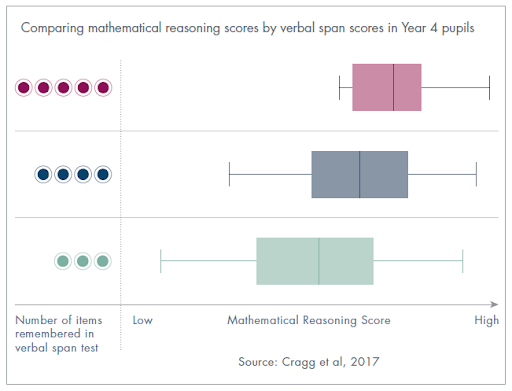
Educational research is showing that for students to be able to manipulate numbers and carry out multi-step procedures they need to maximise their working memory. Although it is difficult to increase working memory, there are ways that it can be freed up. Many of us already know that learning times tables can enable better Mathematical proficiency as it allows greater concentration on the question at hand as the times table result becomes simple recall. With this in mind, we have introduced a weekly tutor time Maths session in secondary to help automate many of the basic procedures students should be familiar with. This is also done in the primary section of the school.
Tactics to free up working memory and improve our Mathematical success
- Make basic tasks familiar - the parts of a question that are familiar are not using working memory, that frees up space in the working memory for the unfamiliar part of a question which helps a student problem solve and solve unfamiliar problems. This starts in primary with learning times tables and number bounds and more complicated procedures are added as they progress. For example an A-level student can be expected to solve a quadratic equation almost automatically whilst they are using their working memory to decide how to solve the larger problem.
- Break larger questions into smaller steps - the smaller steps require less working memory and can be accomplished more easily and more accurately when separated from the larger problem, as each step is completed the focus can then be directed towards what should be done next.
- Regularly review prior work - regular reviews work by making the content familiar, this can be aided by noting similarities to prior knowledge and linking ideas together. Having worked examples to help you review content can be very useful here.
- Extract and note important information - with longer worded problems extract the important information and list it. Use diagrams and lists so you are not trying to keep it all in your head at once.
For more tips and information about freeing up working memory please visit: https://www.edutopia.org/article/7-research-backed-ways-to-boost-working-memory-in-math/