Secondary Mathematics News
7th March 2026
Is Mathematical ability something you are born with, or something you develop?
In the week before half term, I posed this very question to my classes. After a very short discussion nearly all of my students decided it was something that was developed through practice and challenging oneself. As the classes I teach are Year 10 and above, this is not surprising. The A-level students, in particular, firmly believed this to be true, which results from the large number of hours they must invest in the subject to be successful. With the short duration of their course, they can clearly see their rapid increase in their proficiency and their ability to view a problem from different angles as long as they are willing to put in the work.
The "Math Brain" Myth: Oxford Learning specifically states that the idea of a "math brain" is a myth, maths is about training the brain through effort, rather than inborn talent.
If I had asked the younger classes, there would probably be a stronger argument from the students with more of them leaning towards mathematical ability being something one is born with. Research shows that some children are born with a greater innate ability to understand numbers than others, this definitely gives them an advantage when they are young and can often lead to a great love of the subject. However, this can also be a disadvantage as it can lead children to believe that Mathematics should be easy and those that are good at it should not make mistakes or feel the discomfort of challenge. All children can develop and benefit from good Mathematics and problem-solving skills with the correct mindset and the willingness to challenge themselves.
“Society needs to free young people from the "crippling idea that they cannot fail, that they cannot mess up, that only some students can be good at math and that success should be easy and not involve effort," Boaler wrote.
It is from achieving success after a challenging problem that the true reward and joy of Mathematics arises. Once again, we are back to the growth mindset, if you believe your intelligence is not fixed and you are willing to challenge yourself who knows how far you can get!
References: https://ed.stanford.edu/news/cultivating-growth-mindset-math
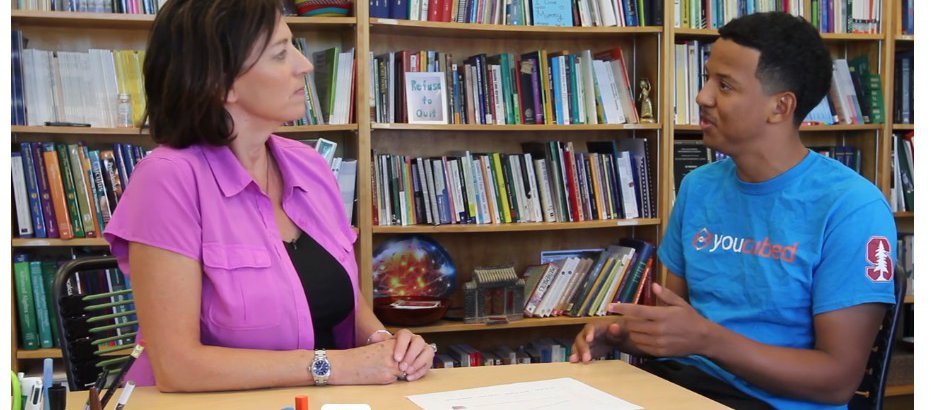
Watch this video to hear Jo Boaler from Stanford University explain how believing in yourself can change your outcomes with respect to Mathematics. https://www.youcubed.org/wim/believe-in-yourself-2/